Inside the Medina: The Neighbourhoods, Gates, and Hidden Stories of Old Marrakech
A deep dive into the historic Medina of Marrakech. Its neighbourhoods, the stories behind its ancient gates, and the city within the walls.
The Medina of Marrakech
The Medina of Marrakech is not simply the old part of the city. It is the city itself. Everything that came after, the French colonial Ville Nouvelle, the modern districts of Gueliz and Hivernage, the sprawling suburbs, all of these exist because the Medina was here first. Founded in 1070 by the Almoravid dynasty, the Medina has been continuously inhabited for nearly a thousand years. It is a UNESCO World Heritage Site, a living museum, and a place where daily life unfolds much as it has for centuries.
Understanding the Medina means understanding Marrakech. Its neighbourhoods each have their own character, their own history, and their own stories. Its gates, the great fortified entrances that punctuate the 19 kilometres of ramparts, were not just functional structures. They were symbols of power, trade, faith, and identity. Each gate has a name, and each name carries meaning.
This guide takes you inside the walls.
The Ramparts
Before exploring the gates and neighbourhoods, it helps to understand the ramparts themselves. The walls of Marrakech were first built by the Almoravids in the 12th century using pisé, a mixture of rammed earth, lime, and local soil that gives them their distinctive rose-pink colour. This is the reason Marrakech is called the Red City, or the Ochre City. The colour of the walls shifts throughout the day, glowing golden at dawn, deep terracotta in the midday sun, and a warm amber at sunset.
The walls stand between 8 and 10 metres high and are punctuated by square towers at regular intervals. They enclose an area of approximately 600 hectares, making the Medina one of the largest in Morocco. Over the centuries, the walls have been repaired, rebuilt, and extended by successive dynasties, but the original route remains largely intact.
The Gates of Marrakech
The Medina has approximately 20 historic gates, known as bab in Arabic. Each gate served a specific purpose, connecting the city to a particular trade route, neighbourhood, or region. Many of the gates still stand today, though their function has evolved from defensive checkpoints to busy traffic intersections. Here are the most significant.
Bab Agnaou
Bab Agnaou is the most beautiful gate in Marrakech and one of the finest examples of Almohad architecture in the world. Built in the 12th century under the Almohad caliph Yaqub al-Mansur, the gate served as the ceremonial entrance to the royal kasbah quarter. The name is believed to derive from the Berber word agnaw, meaning "deaf" or "mute," a reference to the gate's imposing silence and impenetrability. Some scholars suggest it may also mean "people without horns," a Berber term for sub-Saharan Africans, reflecting the gate's position on the trade route south.
The gate is decorated with intricate carved stonework featuring interlocking arches, floral motifs, and Kufic inscriptions from the Quran. Unlike the pisé walls around it, Bab Agnaou is built from a blue-grey stone called Guéliz stone, quarried from the hill that now gives its name to the modern neighbourhood. It is the only stone gate in the entire circuit of walls.
Bab Doukkala
Bab Doukkala takes its name from the Doukkala region on Morocco's Atlantic coast, between El Jadida and Safi. The gate marked the starting point of the road to the coast and was historically the entrance used by traders arriving from the Atlantic ports with goods including fish, salt, and European imports.
The neighbourhood around Bab Doukkala is one of the most traditional in the Medina. The Bab Doukkala Mosque, built in the 16th century by the mother of Saadian Sultan Ahmed al-Mansour, is one of the largest and most important in the city. The area also contains a historic fountain, a hammam, and a former medersa (Islamic school), forming a complete traditional urban complex.
Bab El Khemis
Bab El Khemis means "Gate of Thursday," named after the weekly Thursday market that has been held outside its walls for centuries. The market, known as the souk el khemis, is one of the most fascinating in Marrakech. It is a sprawling flea market where you can find everything from antique furniture and vintage carpets to salvaged doors, ironwork, and curiosities of every kind.
The gate itself is an impressive structure with a horseshoe arch, and the area around it retains a distinctly local, non-touristy character. The Thursday market is a favourite among collectors, dealers, and anyone who enjoys the thrill of the hunt.
Bab Debbagh
Bab Debbagh is the Gate of the Tanners, named after the leather tanneries that have operated in this quarter for centuries. The tanneries of Marrakech are among the oldest in the world, using techniques that have barely changed since medieval times. Animal hides are soaked in vats of natural dyes, including saffron, mint, poppy, and indigo, producing the leather goods for which Morocco is famous.
The gate is one of the most complex defensive structures in the walls, featuring a series of bent passages designed to slow attackers and prevent cavalry charges. Visiting the tanneries is a powerful sensory experience. The smell is intense, the colours are extraordinary, and the scene offers a direct connection to a craft tradition that predates the European Renaissance.
Bab Ailen
Bab Ailen, sometimes written as Bab Aylen, takes its name from the Ailen (or Aylane) tribe, a Berber group that historically inhabited the area outside the gate. The gate is located on the eastern side of the Medina and is one of the less visited by tourists, giving it a quieter, more local atmosphere.
The area around Bab Ailen is residential and traditional, with narrow streets, neighbourhood mosques, and small shops serving the local community rather than visitors.
Bab Er Robb
Bab Er Robb means "Gate of the Grape Juice" or "Gate of the Must," a reference to the fruit juice and grape-based drinks that were once sold in the area. Some historians suggest the name may also relate to the trading of robb, a concentrated fruit syrup used in traditional medicine and cooking.
The gate is located near the Kasbah quarter and the Saadian Tombs, making it a convenient entry point for visitors exploring the southern part of the Medina. The area has been recently restored and now includes a small cultural centre.
Bab Nkob
Bab Nkob is one of the lesser-known gates, located on the southern stretch of the walls near the Mellah (Jewish quarter). The name is thought to derive from a word meaning "holes" or "perforations," possibly referring to the defensive architecture of the gate or to water channels that once passed through the area.
Bab El Makhzen
Bab El Makhzen means "Gate of the Treasury" or "Gate of the Government." It is the main entrance to the Royal Palace (Dar el Makhzen), which occupies a vast area in the southern part of the Medina. The gate is grand, heavily guarded, and not open to the public, but its scale gives an impression of the power and wealth of the Moroccan monarchy.
The Royal Palace has been a seat of government since the Almohad period and remains an active royal residence. The area around Bab El Makhzen includes the Mechouar, the great open esplanade used for royal ceremonies and public gatherings.
Bab Jdid
Bab Jdid means simply "New Gate." It was built more recently than the original Almoravid and Almohad gates, likely during the Saadian or Alaouite period, to provide additional access to the expanding Medina. The gate is located near the Mamounia Hotel and the Koutoubia Gardens, making it a landmark for many visitors.
Bab Laksour
Bab Laksour, also written as Bab Lakssour, translates as "Gate of the Palaces." The name reflects the concentration of important residences and palatial buildings that once existed in the area. This gate is located in the northern part of the Medina and leads into the bustling commercial quarter around Jemaa el-Fna.
Bab Taghzout
Bab Taghzout is named after the Taghzout Berber settlement that existed outside the walls in this area. The gate is located in the northern Medina and leads to the neighbourhood of the same name, which contains several important zaouias (religious lodges) and historic fountains.
The Zaouia of Sidi Bel Abbes, one of the seven patron saints of Marrakech, is located near this gate. Sidi Bel Abbes is the most venerated of the seven saints, and his shrine remains an active place of pilgrimage and prayer.
The Neighbourhoods
Jemaa el-Fna and the Central Souks
Jemaa el-Fna is the beating heart of the Medina and one of the most famous public squares in the world. By day, it is filled with orange juice vendors, snake charmers, henna artists, and musicians. By night, it transforms into an enormous open-air food market, with dozens of stalls serving grilled meats, snails, harira soup, and Moroccan salads.
The name Jemaa el-Fna is debated. It may mean "Assembly of the Dead," referring to a time when the heads of executed criminals were displayed in the square. Others translate it as "Mosque of Nothingness" or "Assembly of the Ruins," possibly referring to a destroyed mosque that once stood here. The square is a UNESCO Intangible Cultural Heritage site.
North of the square, the souks begin. The commercial heart of the Medina is organised loosely by trade: the dyers' souk, the metalworkers' souk, the leather souk, the carpet souk, the spice market. The layout has remained largely unchanged for centuries.
Mouassine
The Mouassine quarter is one of the most refined neighbourhoods in the Medina. Named after the Mouassine Mosque and Fountain, built in the 16th century during the Saadian dynasty, the area is characterised by wide streets (by Medina standards), important historic houses, and an increasingly fashionable collection of boutiques, galleries, and restaurants.
The Mouassine Fountain is one of the grandest public fountains in the city, featuring carved cedarwood, zellige, and a large basin once used for both human and animal drinking water. The neighbourhood has become a centre for design and contemporary culture, with several concept stores and art spaces opening in restored riads along its streets.
The Mellah
The Mellah is the historic Jewish quarter of Marrakech, established in 1558 under the Saadian sultan Moulay Abdallah. The name mellah is thought to derive from the Arabic word for salt, possibly because the Jewish community was historically associated with the salt trade, or because the area was built on saline ground.
At its peak, the Mellah was home to tens of thousands of Jewish residents and was a thriving commercial and cultural centre. Today, only a handful of Jewish families remain, but the heritage is visible everywhere: the Lazama Synagogue (beautifully restored and open to visitors), the vast Jewish cemetery (one of the largest in Morocco), and the distinctive architecture of the houses, which feature outward-facing balconies, a style forbidden in the Muslim quarters.
The Mellah market, known as the Marche Couvert, is one of the best food markets in the city, selling fresh produce, spices, dried fruits, and olives at local prices.
The Kasbah
The Kasbah quarter occupies the southern end of the Medina and was historically the seat of royal power. The word kasbah means fortified citadel, and this area has been the location of palaces, mosques, and government buildings since the Almohad period.
Key sites in the Kasbah include the Saadian Tombs, the El Badi Palace ruins, the Kasbah Mosque (one of the oldest in the city), and the Royal Palace. The neighbourhood has a quieter, more residential character than the central Medina, with wider streets and less commercial activity.
Bab Doukkala
The Bab Doukkala neighbourhood, surrounding the gate of the same name, is one of the most authentic and least touristy areas of the Medina. It is predominantly residential, with a strong community feel and a slower pace of life than the central souks.
The area is home to several important historic buildings, including the Bab Doukkala Mosque and its associated fountain and hammam complex. There are also a number of excellent local restaurants and bakeries that serve the neighbourhood rather than tourists.
Riad Zitoun and Riad Laarouss
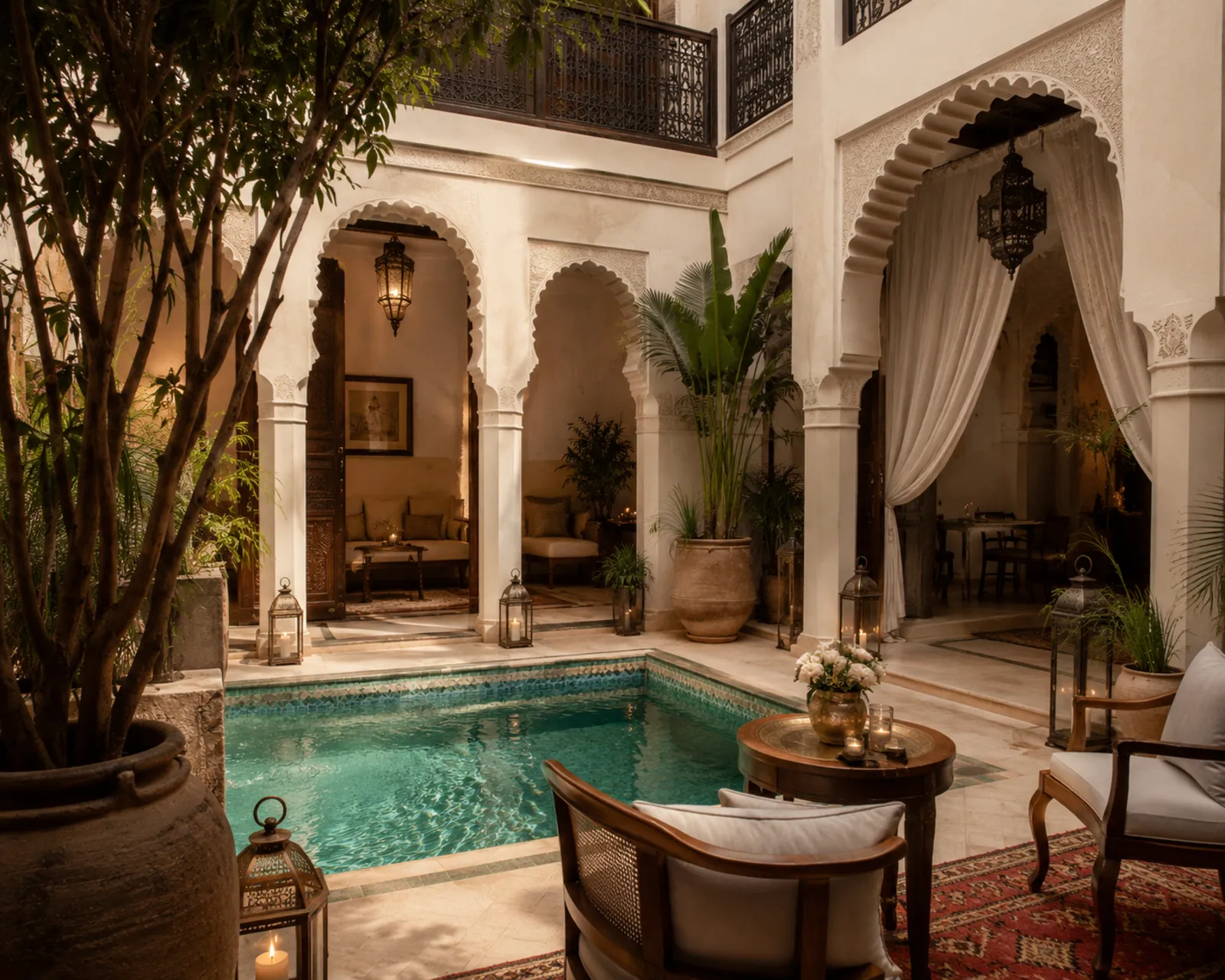
These two neighbourhoods, Riad Zitoun el Kedim (Old Olive Garden) and Riad Zitoun el Jdid (New Olive Garden), run south from Jemaa el-Fna towards the Bahia Palace and the Mellah. The streets here are lined with riads, many of which have been converted into guesthouses and boutique hotels.
Riad Laarouss, located to the east of Jemaa el-Fna, is named after a historic garden that once occupied the site. The neighbourhood is quieter and more residential, with easy access to the central souks.
Sidi Bel Abbes
This neighbourhood in the northern Medina is centred around the Zaouia of Sidi Bel Abbes, the most important of the seven patron saints of Marrakech. The zaouia complex includes a mosque, a mausoleum, a fountain, a hammam, and a market, forming a complete spiritual and social centre.
According to tradition, Sidi Bel Abbes (1130 to 1205) was a scholar and mystic who devoted his life to caring for the blind and the poor. His shrine remains a place of active devotion, and the neighbourhood retains a strong spiritual character.
Kennaria
Kennaria is a small quarter near the Ben Youssef Mosque and Madrasa, historically associated with the canary bird trade. The name derives from the Arabic word for canary, and bird sellers once lined the streets here. Today, the area is known for its proximity to some of the Medina's most important historic sites and its concentration of artisan workshops.
The Seven Saints of Marrakech
No guide to the Medina would be complete without mentioning the seven patron saints, known as the Sab'atou Rijal. These seven Sufi mystics and scholars, who lived between the 12th and 16th centuries, are venerated as the spiritual protectors of Marrakech. Their tombs, scattered across the Medina, form a pilgrimage circuit that has been followed by the faithful for centuries.
The seven saints are Sidi Bel Abbes, Sidi Ben Slimane al-Jazouli, Sidi Abdel Aziz, Sidi Youssef Ben Ali, Sidi Ayad, Sidi Mohamed al-Suhayli, and Sidi Ghalem. Each saint has a zaouia (shrine complex) associated with their tomb, and these sites remain important places of prayer, meditation, and community gathering.
Sultan Moulay Ismail formalised the cult of the seven saints in the 17th century, establishing the pilgrimage route and constructing or restoring several of the zaouias. While the shrines themselves are generally closed to non-Muslims, the neighbourhoods around them are open to all and offer a glimpse into the spiritual life of the city.
Walking the Medina
The Medina is best explored on foot. Cars cannot enter most of the streets, and even motorcycles struggle in the narrowest alleyways. Getting lost is part of the experience, though it can be disorienting for first-time visitors.
A few practical tips for walking the Medina. Keep the Koutoubia Mosque minaret as your reference point. It is visible from many rooftops and elevated positions, and it marks the western edge of the Medina near Jemaa el-Fna. When in doubt, ask a shopkeeper for directions. Most will point you in the right direction without expecting anything in return.
Wear comfortable shoes. The streets are uneven, sometimes slippery, and often stepped. Carry water, especially in summer. And allow yourself to wander without a fixed itinerary. The best discoveries in the Medina are the ones you stumble upon by accident.
Experience the Medina with Us
At The Marrakech Curator, we arrange private guided tours of the Medina with local experts who were born and raised within the walls. Our guides bring the history, the stories, and the hidden details to life in a way that no guidebook can match.
Whether you want a comprehensive full-day tour covering the major sites or a focused walk through a specific neighbourhood, we tailor the experience to your interests. Tell us what fascinates you, and we will create a route that reveals the Medina in all its depth and beauty.