The Agafay Desert: A Complete Guide to Marrakech's Stone Wilderness
Forty-five minutes south of Marrakech lies a stone desert with the High Atlas as its backdrop. A complete guide to visiting the Agafay — when to go, how long to stay, what to do, and what to pack.
Where the city ends and the silence begins
Forty-five minutes south of Marrakech, the road climbs gently away from the palm groves and red ramparts of the city, and something strange happens. The trees thin out. The traffic disappears. The horizon opens up into a vast, undulating expanse of pale ochre and grey, dotted with low scrub and the occasional Berber shepherd guiding his flock across the slopes. You have arrived in the Agafay Desert, a landscape that feels lifted from another planet, with the snow-capped peaks of the High Atlas mountains forming a dramatic backdrop in the distance.
Many of our guests at The Marrakech Curator are surprised to learn that the closest desert to Marrakech is not a desert in the cinematic sense at all. There are no towering golden dunes here, no shifting sands like the ones you see in films set in the Sahara. The Agafay is what geologists call a stone desert, or hamada — a high, arid plateau of compacted earth, fine gravel, and weathered limestone, sculpted over millennia by wind, sun, and rare but violent rainfall. It is precisely this otherworldly, almost lunar quality that has made it one of Morocco's most coveted day trip destinations and, increasingly, an overnight escape in its own right.
This guide is for the traveller who wants to understand the Agafay properly: where it is, how to get there, what to do once you arrive, what to pack, where to stay, and how to make the most of a stretch of land that exists in the middle of nowhere yet sits practically on Marrakech's doorstep.
Understanding the Agafay: a stone desert, not a sand desert
The first thing to establish, because it shapes every expectation you should have, is that the Agafay is not the Sahara. The Sahara begins much further south and east, beyond the Atlas mountains, in places like Merzouga and the Erg Chebbi dunes, or M'Hamid and the Erg Chigaga. Reaching those true sand seas requires a serious commitment: typically two days of driving each way from Marrakech, or an internal flight followed by several hours on the road.
The Agafay offers something quite different. It is a pre-Saharan landscape, technically a semi-arid steppe, characterised by rolling hills of grey and beige stone that catch the light beautifully at sunrise and sunset. The terrain is firm underfoot, easy to walk on, and entirely accessible to ordinary vehicles. There are scattered Berber villages, a handful of working farms, ancient mule tracks, and the occasional argan or olive tree clinging to the slopes.
What makes the Agafay magical is the contrast. To the north, you see the dusty silhouette of Marrakech in the distance. To the south and east, the High Atlas rises sharply, snow-capped in winter and spring, providing a backdrop that no Saharan desert can match. The light is constantly changing. The silence, once you walk a few hundred metres from any camp or road, is absolute. And the night sky, far from any city light pollution, is a revelation.
For travellers who want a genuine desert experience without sacrificing several days of their Moroccan holiday, the Agafay is unmatched. It is also a far more comfortable proposition for families with young children, older travellers, or anyone whose schedule simply does not allow for a longer expedition.
How to get to the Agafay Desert
The Agafay sits roughly thirty to forty kilometres south of Marrakech, depending on which part of the desert you are heading to. The total drive time from the centre of the city is typically between forty-five minutes and one hour, traffic dependent.
You have several options for reaching it. The most straightforward is a private transfer arranged through your villa, riad, or concierge service. This is the option we recommend to our guests at The Marrakech Curator because it removes all logistical friction. A driver collects you from your accommodation, takes you directly to your camp or activity provider, waits or returns at the agreed time, and brings you back. There is no parking to worry about, no risk of getting lost on the unmarked tracks that lead to the more secluded camps, and you arrive relaxed.
The second option is to drive yourself. Most major car rental companies in Marrakech offer suitable vehicles, and the route is reasonably well signposted as you head out of the city towards Lalla Takerkoust and the Kik Plateau. The roads are paved most of the way, but the final approach to many camps involves a stretch of unpaved track that can be rough. A standard saloon car will manage in dry weather, but anything wet or windy and you will appreciate higher ground clearance. We do not particularly recommend self-driving for first-time visitors to Morocco, simply because Moroccan road etiquette takes some getting used to.
The third option is a group day trip booked through a local tour operator. These tend to be the most affordable but also the most rigid in terms of timing and inclusions. You will be on someone else's schedule, sharing a vehicle with strangers, and visiting a camp that has been chosen for the operator's commercial relationships rather than your personal taste.
Whichever route you choose, plan your travel for the cooler edges of the day. Leaving Marrakech around nine in the morning, or after three in the afternoon, makes for the most pleasant journey and aligns with the best light for photography once you arrive.
When to visit the Agafay
The Agafay is accessible year round, but the experience varies dramatically by season.
Spring, from March to May, is widely considered the best time to visit. Daytime temperatures are warm but not punishing, the wildflowers bring unexpected colour to the slopes, and the Atlas mountains are still topped with snow. Evenings are cool enough to enjoy a fire pit at camp.
Autumn, from late September through November, offers similarly comfortable conditions. The summer heat has broken, the light is golden and soft, and the desert has a settled, contemplative atmosphere.
Winter, from December to February, is colder than many travellers expect. Daytime temperatures are pleasant for activities, often in the high teens or low twenties Celsius, but nights drop sharply, occasionally close to freezing. If you visit in winter, the better camps provide hot water bottles, thick wool blankets, and wood-burning stoves in the tents. The clear winter air offers exceptional views of the snow-covered Atlas.
Summer, from June to August, is the most challenging season. Daytime temperatures regularly exceed forty degrees Celsius, making outdoor activities uncomfortable or unwise during the middle of the day. If you must visit in summer, schedule everything for early morning or after five in the afternoon, and look for camps with serious pool infrastructure. Evenings are spectacular, with warm dry air and exceptional star visibility.
How many nights to stay in the Agafay
This is one of the most common questions we receive, and the answer depends entirely on what you are looking for.
A day trip of six to eight hours is enough to experience the headline activities: a quad bike or buggy ride, a camel trek, a long lunch with a view, and perhaps a swim. You return to Marrakech in the early evening with a full memory card and a deep sense that you have done something quite different from the souks and the medina.
One night in an Agafay camp is, in our view, the sweet spot for most travellers. You arrive in the late afternoon, settle into your tent or yurt, watch the sun set over the desert with a drink in hand, enjoy a long candlelit dinner, sleep under the stars, wake to mint tea and a Berber breakfast, and depart by mid-morning. This rhythm captures the magic of the place without overstaying.
Two nights is for travellers who genuinely want to disconnect. With two nights, you have one full day in the desert with no transit, allowing you to layer in activities at a relaxed pace, take a hammam treatment, read a book by the pool, take a long walk through the surrounding hills, and truly absorb the silence. We recommend two nights particularly to honeymooners, writers, and anyone arriving in Marrakech for an extended stay who wants a contemplative interlude.
Three nights or more starts to feel long for most visitors, simply because there is a finite list of activities and the visual landscape, however beautiful, does not change much. The exception is travellers who are using a desert camp as a base for hiking, cycling, or longer Atlas excursions, in which case extended stays make sense.
For most of our guests at The Marrakech Curator, we suggest combining a one-night Agafay stay with a longer stay in one of our curated villas or riads in the city. The contrast between the two experiences — urban sensory overload followed by absolute silence — is one of the great pleasures of a well-designed Moroccan trip.
What to do in the Agafay Desert
The Agafay has developed a remarkably full menu of activities over the past decade, ranging from gentle and sensory to genuinely adrenaline-fuelled.
Quad biking and dune buggies
Quad biking is the signature Agafay activity. The terrain is ideally suited to it: open, rolling, with enough variation to stay interesting and few obstacles to make it dangerous for beginners. Most operators offer guided rides of one to three hours, with the ninety-minute option being the most popular. You ride in convoy behind a guide, with stops for photos and tea, covering perhaps fifteen to twenty-five kilometres of trail.
Dune buggies, sometimes called UTVs or side-by-sides, are a more comfortable alternative for couples or anyone who prefers a roof and a seatbelt to a saddle. They are also significantly more powerful and fun for confident drivers.
Camel rides
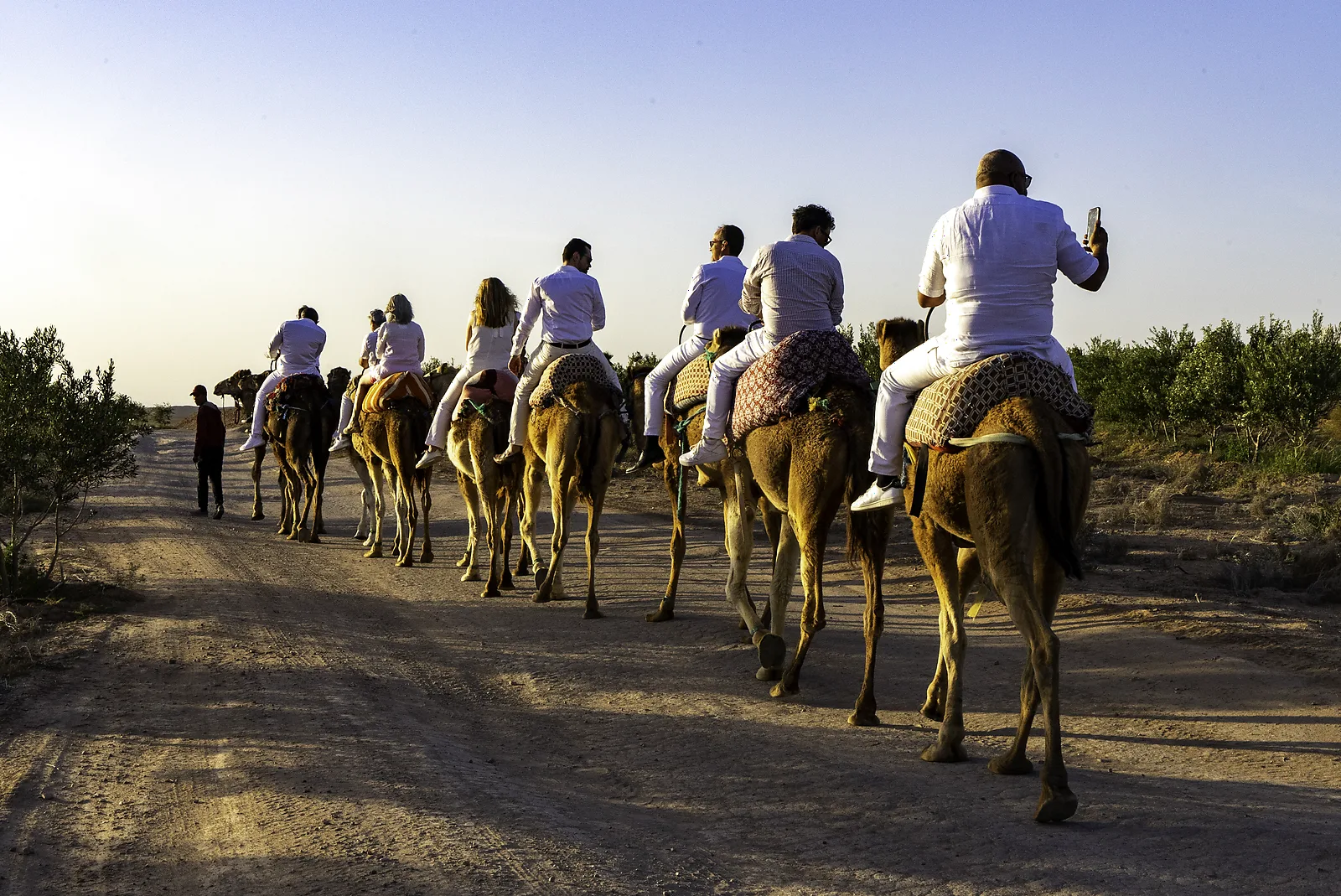
The Agafay camel ride is shorter and more sedate than what you would experience in the Sahara, typically lasting between forty-five minutes and ninety minutes. Most operators schedule rides for late afternoon, timed to coincide with sunset. You sit on a wooden saddle covered in colourful blankets, walking in single file behind a guide, while the light turns the surrounding hills from beige to gold to deep rose. It is unhurried, photogenic, and surprisingly meditative.
Hot air ballooning
For travellers willing to wake up well before dawn, a hot air balloon flight over the Agafay is one of the most spectacular experiences available anywhere in Morocco. Flights launch at first light, drift silently across the desert and the foothills of the Atlas for around an hour, and conclude with a Berber breakfast under a tent. Bookings should be made well in advance, particularly in spring and autumn.
Horse riding
Several outfits offer horseback excursions through the Agafay, ranging from gentle one-hour walks for beginners to half-day rides for experienced equestrians. The horses are typically Arabian or Barb crosses, well cared for, and accustomed to the terrain.
Hiking and trail running
The Agafay rewards anyone willing to walk away from the camps. Marked trails are limited, so most hikes are guided, but the terrain is forgiving and the sense of solitude immediate. For trail runners, the network of mule tracks offers excellent off-road running with significant elevation variation if you head towards the Atlas foothills.
Mountain biking
The same trails that suit quad bikes work beautifully for mountain bikes, and several operators now offer guided rides ranging from gentle morning loops to challenging full-day expeditions linking the Agafay with Lake Lalla Takerkoust and the Atlas foothills.
Spa, hammam, and pool days
Many of the higher-end camps have invested heavily in wellness infrastructure: heated pools, traditional hammams, massage tents, and yoga decks oriented towards the Atlas. For travellers who want the desert as a backdrop rather than a playground, a spa day in the Agafay is a beautiful and underrated way to spend a day.
Stargazing
After dinner, the Agafay reveals one of its greatest gifts. With no light pollution and very little humidity, the night sky is dense with stars. Many camps provide blankets and floor cushions for stargazing, and a few have telescopes or organise occasional astronomy evenings.
Lake Lalla Takerkoust
A short drive from the heart of the Agafay brings you to Lake Lalla Takerkoust, a turquoise reservoir set against the Atlas mountains. The lake is a popular stop for lunch on a day trip from Marrakech and offers boat rides, jet skis, and lakeside restaurants. It is not an essential stop, but it adds a refreshing change of scenery to a day in the desert.
The camps of the Agafay
The Agafay is now home to dozens of camps, ranging from rustic Berber-style installations to genuinely luxurious tented retreats with infinity pools, fine dining, and spa facilities. Choosing the right camp matters enormously to the quality of your experience.
At the upper end of the market, camps like Be Agafay and Inara have set new standards for what a desert stay can be, with beautifully designed tents featuring proper beds, en-suite bathrooms, electricity, heating, and outdoor terraces with uninterrupted views. Common areas are styled with restraint: low Berber furniture, woven rugs, lanterns, and fire pits. Food is taken seriously, often with a single nightly menu prepared by a Moroccan chef working with local ingredients. These camps are appropriate for honeymooners, design-conscious travellers, and anyone for whom comfort is non-negotiable.
In the mid-range, you will find a wide selection of well-run camps offering tented accommodation with hot showers, private bathrooms, and good food, typically organised around a central pool and dining tent. These camps work beautifully for families and groups of friends and offer most of the magic of the higher-end options at a more accessible price point.
At the budget end, simple Berber camps offer shared facilities, basic tents, and a more rustic experience. These can be wonderful for adventurous travellers, but the comfort gap is significant and we generally do not recommend them to our guests.
A few practical notes on camp selection. First, location matters: the camps deeper in the desert offer greater silence and better stargazing, but require slightly longer transfers. Second, ask about heating in winter and air conditioning in summer, as the temperature extremes are real. Third, if you are sensitive to noise, ask about the camp's policy on amplified music in the evenings, as some camps host lively dinner shows that may not align with the contemplative escape you had in mind.
What to pack for the Agafay
Packing for the Agafay is a small art form, because the desert demands more thought than a typical city stay. Here is what we suggest, organised by category.
For your feet, comfortable closed-toe shoes are essential. Trainers or hiking shoes work perfectly. Sandals and open shoes are not recommended for activities, as the gravel gets everywhere and the stones can be sharp. Pack one pair of comfortable shoes for the camp itself, ideally ones you can slip on and off easily.
For your body, layering is the rule. Daytime can be warm to hot depending on the season, but evenings cool quickly once the sun sets, and the temperature drop in winter is dramatic. Bring light, breathable clothing for the day, a fleece or sweater for the late afternoon, and a proper jacket for the evening. Long sleeves and trousers are useful for both sun protection and the cool of the evening. Natural fibres breathe better than synthetics in the dry heat.
For your head, a wide-brimmed hat or a Moroccan keffiyeh is essential during the day. The sun in the Agafay is intense even in winter, and there is almost no natural shade outside the camps. Sunglasses with proper UV protection are non-negotiable.
For quad biking and other dusty activities, bring or borrow a scarf or buff that you can pull up over your nose and mouth. The fine dust of the Agafay is no joke and will work its way into everything. Reputable operators provide goggles, but if you wear contact lenses or have sensitive eyes, your own wraparound sunglasses are useful as a second layer.
For your skin, high-factor sun cream applied generously and often is essential. The dry air dehydrates skin quickly, so a rich moisturiser is welcome at the end of the day. Lip balm with SPF protects against chapping.
For hydration, bring a refillable water bottle. Most camps offer filtered water, and a one-litre bottle that you can carry on activities will save you constantly asking for refills.
For your camera, the Agafay is one of the most photogenic landscapes in Morocco, particularly at golden hour. A good camera or a smartphone with a decent lens will reward you. Bring a microfibre cloth, as dust on the lens is constant. If you are travelling with serious camera equipment, a small dust-proof bag is a good idea.
For the evening at camp, something cosy to wear after dinner makes the whole experience more pleasurable. Cashmere, soft wool, or fleece are all appropriate. Pyjamas with a long sleeve and trouser are wise in winter.
For personal items, pack any prescription medications, basic first aid, insect repellent for the warmer months, and a small torch or headlamp for moving between your tent and the central areas of camp at night.
Finally, travel light. Most camps will transfer your luggage from the parking area to your tent, but the paths can be uneven. A soft duffel or holdall is more practical than a rigid suitcase.
What to expect: the rhythm of a day in the Agafay
A day in the Agafay has its own particular rhythm, quite different from anything you will experience elsewhere in Morocco.
You arrive, typically in the late afternoon if you are staying overnight or late morning if you are visiting for the day. You are greeted with mint tea and a cool flannel, and shown to your tent or to a shaded seating area. The first thing you notice, after the visual drama of the landscape, is the quiet. The wind is the loudest sound, and even that comes and goes.
The middle of the day, if you are staying, is for slow pleasures: a swim, a long lunch under canvas, a nap, a book. Activities are scheduled for the cooler edges of the day, late afternoon and early morning, both for comfort and for light.
Sunset is the headline event. You watch it from a quad bike, from the back of a camel, from a lounger by the pool, or from the comfort of your terrace with a glass of something cold. The light show lasts longer than you expect, with the sky shifting through pinks and purples for half an hour after the sun has dropped behind the Atlas.
Dinner is taken communally in most camps, often around a single long table or by candlelight in the dining tent. Menus are typically Moroccan with international touches, and most camps cater easily for dietary requirements with advance notice. Wine and other alcoholic drinks are usually available but at a markup.
After dinner, the night opens up. Some camps have musicians, others have a fire pit and silence. The stars, on a clear night, are extraordinary. Many guests find themselves staying up far later than they had planned, simply because the night is so beautiful.
You sleep deeply in the desert silence and wake, usually, to a soft pre-dawn chill and the call of birds. Breakfast is unhurried, and by mid-morning you are back on the road to Marrakech, slightly sun-tinted, slightly windswept, and quietly transformed.
A few honest words of advice
The Agafay has become genuinely popular over the past five years, and with popularity comes a degree of unevenness. Not every camp is what it claims to be in its photography. Not every operator is professional. Booking through a trusted curator, your villa concierge, or a reputable agency saves you from the disappointment of arriving somewhere that does not match the marketing.
Be realistic about the scale of the Agafay. It is not the Sahara, and a traveller arriving with cinematic dune expectations will leave disappointed. Approach it for what it is — a stark, beautiful, accessible stone desert with the High Atlas as its backdrop — and you will be rewarded.
Finally, leave room in your plans for slowness. The greatest gift of the Agafay is not what you do there, but what you stop doing. The phone signal is patchy, the WiFi is rarely a priority for the better camps, and the days have a way of stretching out in the most generous fashion. Bring a book you have been meaning to read. Bring a notebook. Bring your favourite person and very few plans. The desert will do the rest.
Planning your visit with The Marrakech Curator
For guests staying in our curated villas and riads in Marrakech, we are happy to organise every aspect of an Agafay experience: private transfers, the right camp for your taste and budget, pre-booked activities at the best operators, and a smooth handover at every step. Whether you are looking for a single magical evening under the stars or a multi-night escape into the silence, we can shape the experience around exactly what you need.
The Agafay is, in many ways, the perfect counterpoint to the intensity of Marrakech: the stillness after the storm, the empty page after the densely written one. Used wisely, it transforms a good Moroccan trip into an unforgettable one.