The 5 Best Fine Dining Restaurants in Marrakech: La Grande Brasserie, L'Asiatique, Arva, Rivayat & Sabo
La Grande Brasserie, L'Asiatique, Arva, Rivayat, Sabo: 5 signature fine-dining tables inside Marrakech's grandest hotels. Curated by The Marrakech Curator.
In Marrakech, the best fine-dining tables don't sit on the street. They sit inside the city's grandest hotels — properties where the kitchen has a chef of international standing, the service team has rehearsed a single tasting menu for a season, and the room has been designed to make every course feel like an event. The result is a category of evening you cannot replicate in a stand-alone restaurant: gastronomy embedded inside hospitality, sometimes with a Michelin-trained chef personally responsible for fewer than thirty covers a night.
Over a decade of orchestrating villa stays in Marrakech, we have built direct relationships with the maître d's of the city's most defensible fine-dining rooms. Each is housed inside a hotel that requires no introduction. Each runs to its own specific standard. And each holds its place not because it photographs well on Instagram, but because the cuisine, the service and the room move together with rare discipline.
This is our 2026 list, curated for guests who treat dinner as the centerpiece of an evening — not a footnote to it. The five restaurants below are presented in no particular ranking — each occupies a different cuisine and mood, and the right one for your evening depends on what you want from the night.
Why Fine Dining in Marrakech Lives Inside the Great Hotels
Marrakech has a strong stand-alone restaurant scene — the supper clubs of Hivernage, the riad terraces of the medina, the contemporary tables in Guéliz. But the city's most disciplined kitchens are inside the five-star hotels. There are three reasons for this. First, only a hotel kitchen can amortize the cost of a Michelin-trained chef, a fully equipped pastry brigade and a multi-language service team across both restaurant and room service. Second, a hotel restaurant draws a guaranteed in-house clientele every night — which lets the kitchen plan a tasting menu around fresh, low-volume ingredients without worrying about empty tables. Third, the great Marrakech hotels have spent fifteen years building reputations they are unwilling to risk on inconsistent cooking. The result is that the five rooms below operate to standards stand-alone restaurants in the city cannot match week in, week out.
For our guests staying in private villas and riads, dining inside one of these hotels is also the simplest way to experience the property without booking a room. We coordinate the reservation, the private transfer from your villa or riad, and any specific table or celebration request — you arrive, eat, and return to your own bed.
1. La Grande Brasserie at Royal Mansour — Yannick Alléno's Marrakech Brasserie
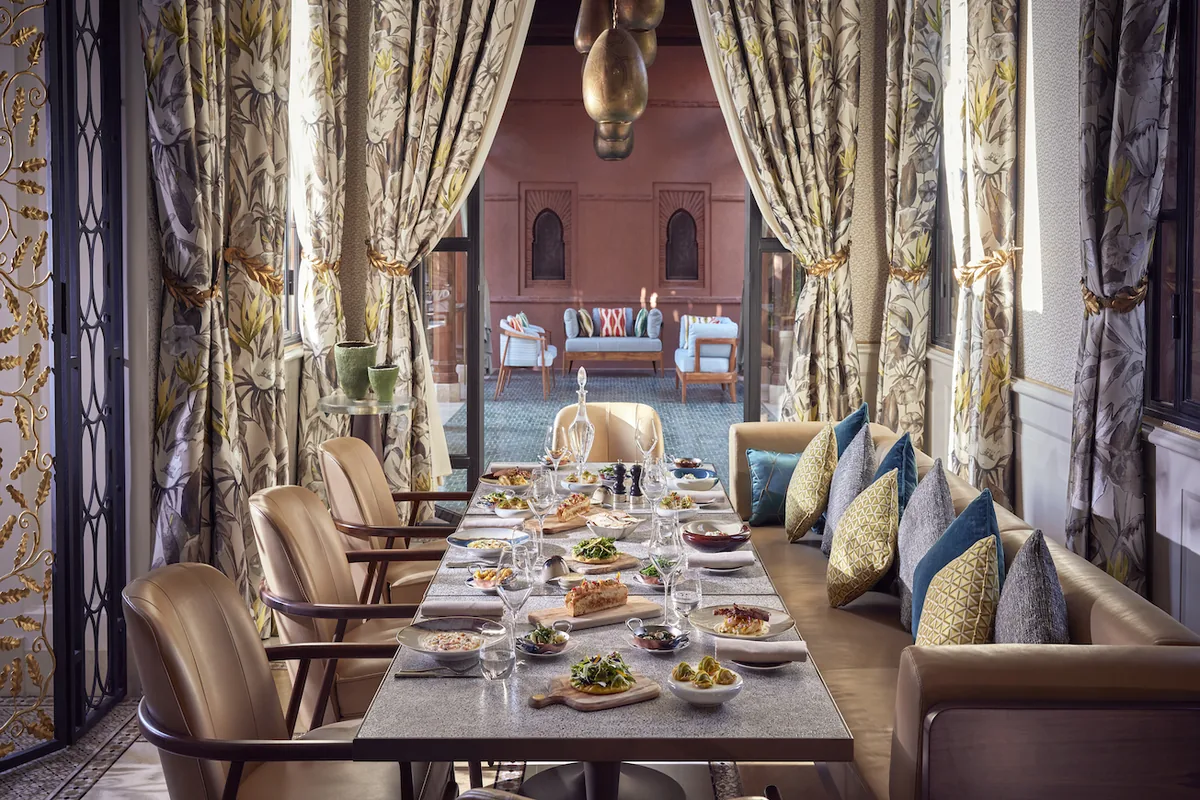
- Location: Royal Mansour Marrakech, Rue Abou Abbas El Sebti
- Cuisine: Refined French brasserie, programme by chef Yannick Alléno
- Setting: Theatrical dining room with central oyster bar and open kitchen
- Dress code: Elegant, smart attire
- Reservations: Essential
Royal Mansour Marrakech is the King Mohammed VI-commissioned palace hotel that opened in 2010, designed as a private medina of 53 individual riads each with its own roof terrace, swimming pool and butler. The dining programme is supervised by Yannick Alléno — the three-Michelin-star French chef behind Pavillon Ledoyen in Paris — who has overseen the property's restaurants since 2020. La Grande Brasserie is the most accessible expression of his Marrakech work: a brasserie format with the rigour of fine dining behind every plate.
The menu reads as a Parisian grande brasserie reinterpreted with Moroccan elegance: sole meunière, steak tartare prepared tableside, côte de bœuf for two, signature seafood platters built around oysters from Dakhla and langoustines from the Atlantic coast. The kitchen executes at brasserie speed but with three-star precision: every plate consistent, every sauce on point, every fish cooked correctly. The wine list is French-leaning with strong Champagne and Burgundy sections.
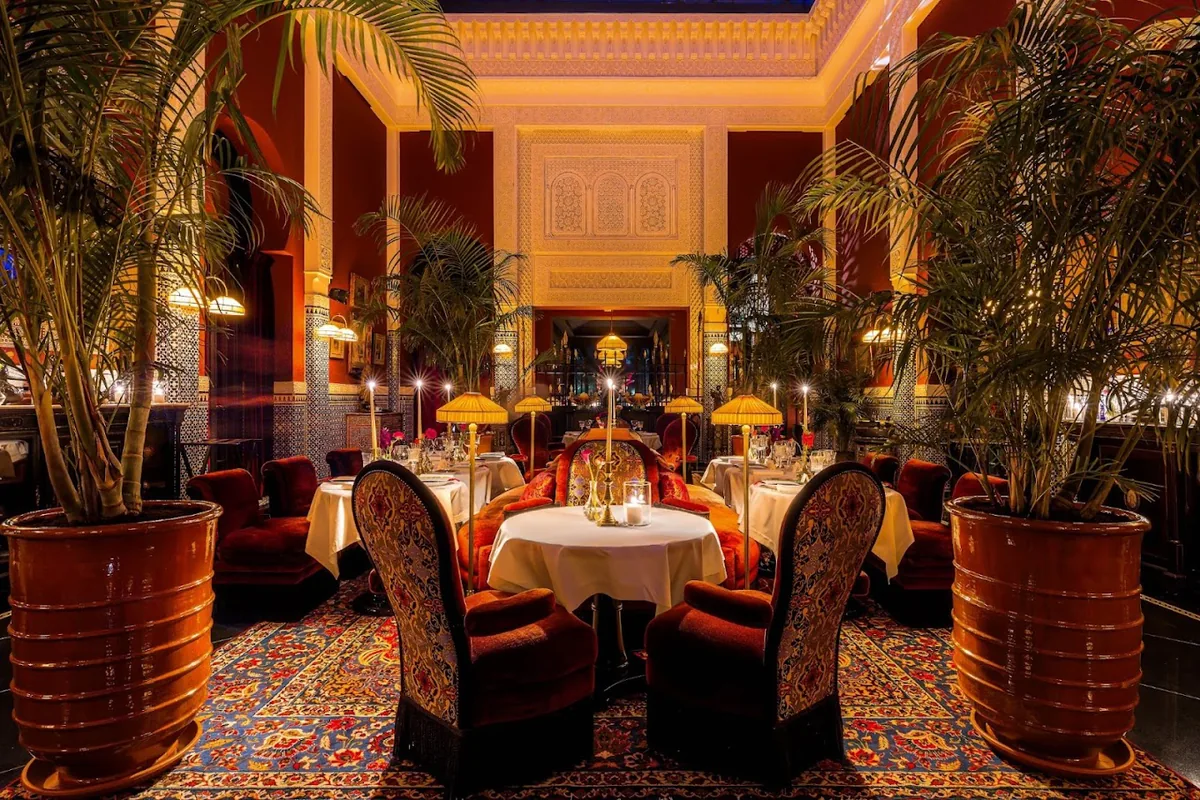
The room is one of the most theatrical dining environments in the city — gold-trimmed columns, velvet curtains, a central oyster bar, an open kitchen that lets guests see the service choreography in real time. The noise level stays civilised thanks to a calibrated room design. The energy is lively but not loud, and the room suits guests who want fine-dining quality served in a setting that feels less hushed than a tasting-menu restaurant.
The Curator's tip: La Grande Brasserie is the right choice for a celebratory dinner with a group of four to six who want energy and quality in the same evening. We can request the central banquettes that give the best view of the open kitchen, and the maître d' will coordinate Champagne service and any celebration details. Royal Mansour is an easy ten-minute drive from most riads and villas in the medina or Hivernage.
2. L'Asiatique at La Mamounia — Jean-Georges Vongerichten Inside the Most Iconic Hotel in Morocco
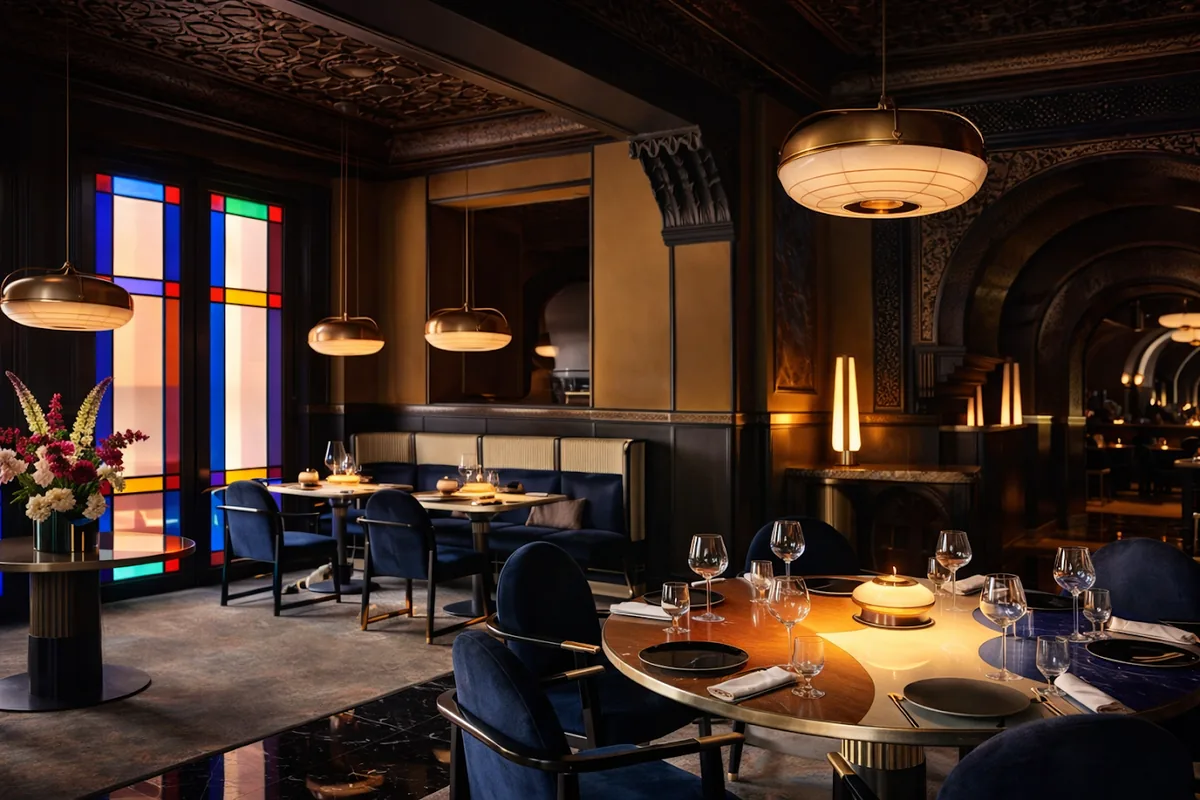
- Location: La Mamounia, Avenue Bab Jdid, Marrakech medina
- Cuisine: Pan-Asian, signature Jean-Georges Vongerichten
- Setting: Jacques Garcia-designed dining room, deep emerald palette
- Dress code: Elegant, jacket recommended for men
- Reservations: Essential — book one to two weeks ahead in high season
La Mamounia needs no introduction. The 1923 hotel inside Marrakech's medina has been the address of choice for heads of state, royalty and the European film world for a century, and its 2009 Jacques Garcia refurbishment brought the property into a register that competes with any palace hotel in Europe. Of its multiple dining rooms, L'Asiatique by Jean-Georges Vongerichten is the kitchen we send guests to when they want the precision of an international Michelin culture inside a setting that is unmistakably Moroccan in scale and design.
L'Asiatique is Jean-Georges' Marrakech expression of the pan-Asian vocabulary he has developed across his restaurants in New York, Hong Kong, London and Paris. The menu travels through Thailand, Vietnam, China and Japan with the chef's hallmark precision: rice-paper rolls with fresh herbs and tamarind, miso-glazed black cod, char siu pork belly, gentle curries that read as sophisticated rather than aggressive. The wine list is one of the strongest in Morocco — sake, white Burgundy and a small selection of Moroccan estates that pair surprisingly well with the kitchen's lighter dishes.
The room is pure Garcia: deep emerald walls, lacquered wood, lantern lighting, and a calculated sense of mystery. The energy is markedly different from Mamounia's other restaurants — quieter and more intimate than Le Marocain, more theatrical than L'Italien. Service is European-trained, multilingual and impeccable.
The Curator's tip: L'Asiatique is the right choice for a milestone dinner — anniversary, engagement, significant birthday — when guests want the recognition of an internationally famous chef paired with the most iconic setting in Marrakech. We can request the alcove tables that offer the most privacy, and the maître d' will coordinate any celebration details discreetly.
3. Arva at Amanjena — Italian Refinement at the Aman Resort
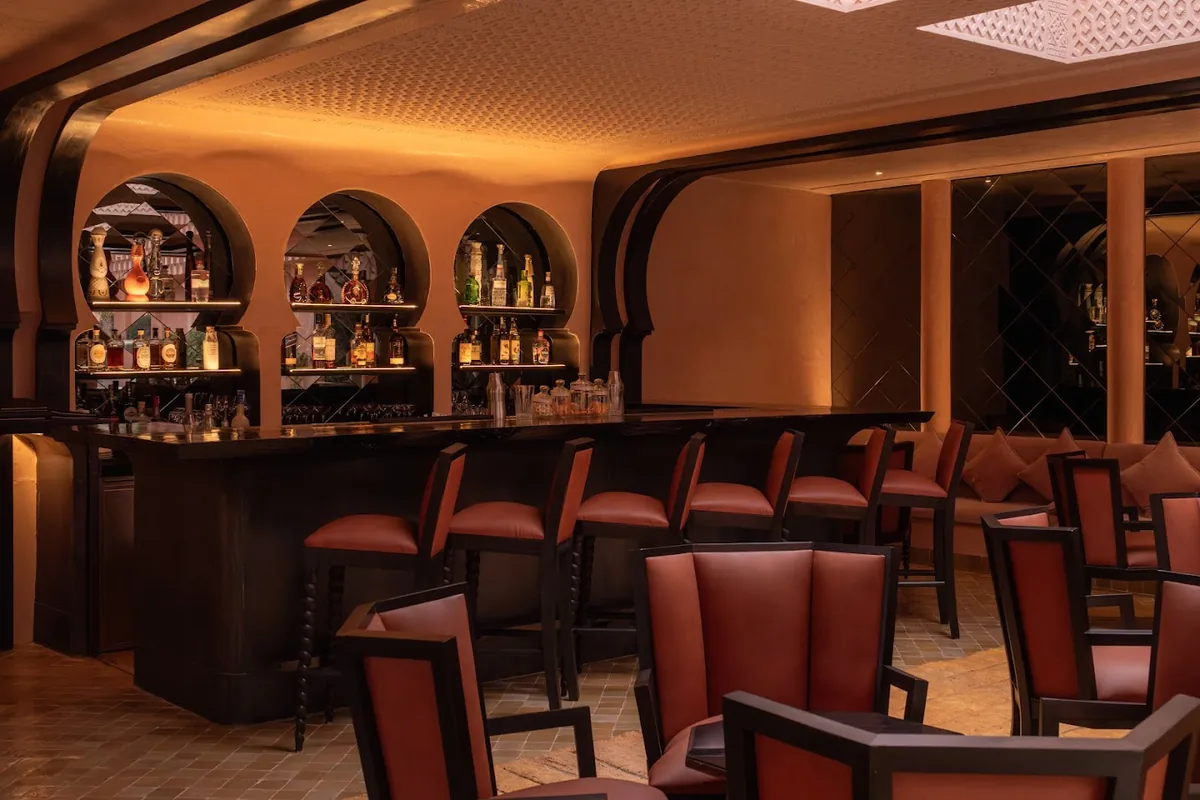
- Location: Amanjena, Route de Ouarzazate, KM 12
- Cuisine: Regional Italian, Aman's signature Arva concept
- Setting: Dining room and terrace opening onto the central basin
- Dress code: Elegant, resort chic
- Reservations: Essential
Amanjena is the Aman group's Marrakech resort, opened in 2000 on the road toward Ouarzazate. The property is built around a central reflecting basin echoing the historic Moroccan agdal — a vast still-water source surrounded by colonnades, palms and pisé walls in the unmistakable Aman house style. The energy is monastic, hushed and absolutely contemporary in its restraint. Arva is the resort's Italian restaurant — part of the Arva concept the group has rolled out at Aman Venice, Amanyangyun and Amangiri — and it remains one of the most surprising fine-dining tables in Marrakech.
Arva translates from Latin as "from cultivated land," and the kitchen takes the brief literally: regional Italian cuisine sourced where possible from Moroccan and Italian growers, prepared with the precision Aman insists on across its global culinary program. Expect handmade pasta — tagliolini with truffle, ravioli with ricotta and herbs from the property's own gardens, slow-cooked braised meats served with restraint — alongside wood-fired pizzas on the lighter side of the menu. The wine list leans Italian as expected, with careful selections from Tuscany, Piedmont and Veneto, and a small Moroccan section curated to pair with the kitchen's lighter dishes.
The dining room opens onto the central basin, and the night light reflected off the still water is one of the calmest dining experiences in Marrakech. Service is precise, Aman-trained: every server speaks at least three languages, every plate arrives at the correct temperature, every guest is greeted by name from the second visit onward.
The Curator's tip: Arva is the right choice for guests who want a quiet, elegant dinner with an unmistakably Italian vocabulary in the most architecturally serene setting Marrakech offers. Request a table close to the basin colonnade for the best ambient light. Amanjena sits about twenty minutes from most villas in La Palmeraie and the medina — we coordinate transfers so guests arrive together.
4. Rivayat at The Oberoi Marrakech — Refined Indian Cuisine in a 28-Hectare Olive Grove
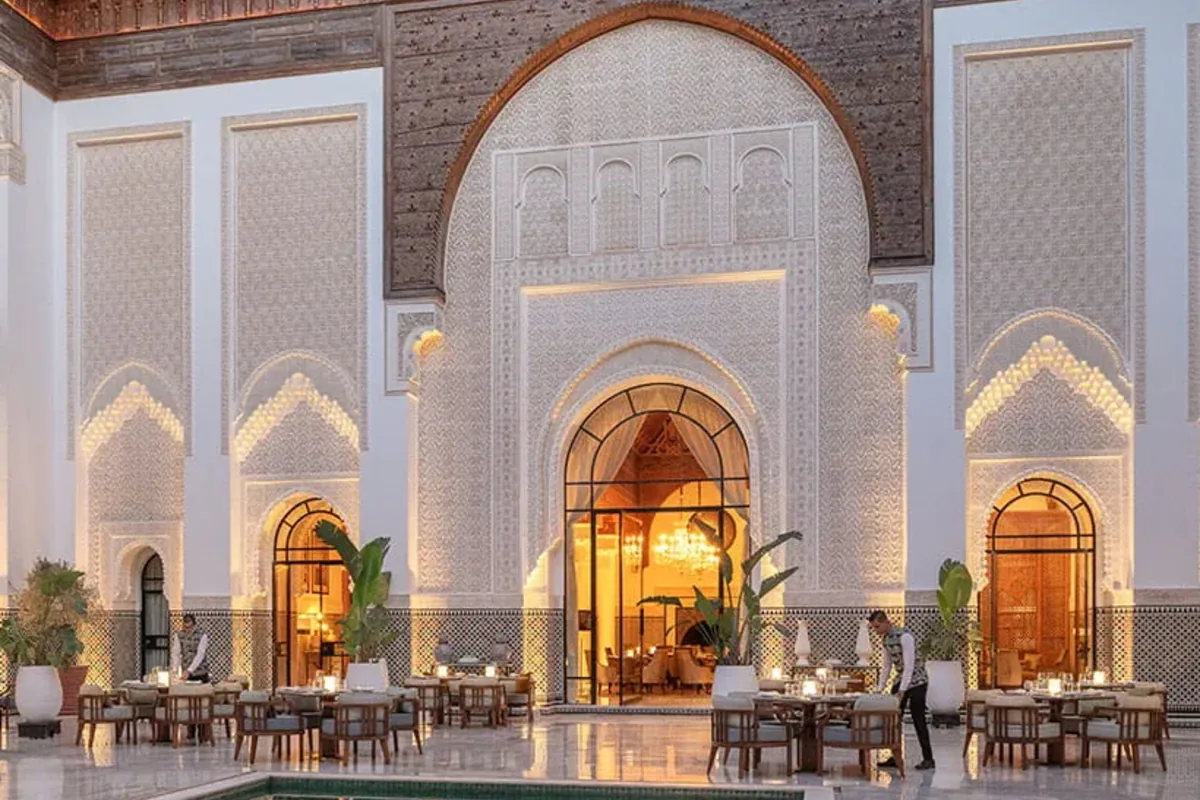
- Location: The Oberoi Marrakech, Tassoultanté, Route d'Ouarzazate
- Cuisine: Refined Indian, regional tasting menu format
- Setting: Indoor room with hand-carved cedar screens, terrace overlooking the olive groves
- Dress code: Smart, elegant
- Reservations: Essential — limited covers per night
The Oberoi Marrakech opened in 2019 on a 28-hectare olive grove south of the city, and it remains the property that surprises first-time guests the most. Designed in collaboration with leading Moroccan craftsmen — zellige work that runs to the millimetre, sculpted plaster ceilings, hand-carved cedar screens — it pairs the precision of Oberoi service culture with the depth of Moroccan craftsmanship. Service is exact in a way few other Marrakech hotels match: a maître d' who remembers a guest's preferred water two visits later, a sommelier who knows the wine list to the vintage, a kitchen team that adjusts to allergies and dietary requests without a hint of friction.
Rivayat is the signature Indian restaurant that has defined Oberoi dining at the group's flagship properties in India and Bali, and the Marrakech expression honours the original brief. The kitchen serves classical Indian regional cuisine prepared with absolute control: a tasting menu that travels from Hyderabadi biryani to coastal Kerala fish curry, soft khameeri breads from the tandoor, and a vegetarian menu that reads as the equal of the meat selection rather than an afterthought. Each course arrives with a one-line explanation of provenance from the server, delivered without ceremony.
The room is one of the most architecturally serious in Marrakech: hand-carved cedar screens, lantern-lit terraces opening onto the olive groves, and a sound register that stays close to silence. The energy is intimate — the kitchen serves no more than around thirty covers a night, and the maître d' protects the rhythm of the room with care.
The Curator's tip: Rivayat is the right table for guests who appreciate Indian cuisine and want it executed at the level of a Michelin-trained kitchen. Request a terrace table at sunset and arrive by 19:30 to catch the last light over the olive groves before service begins. The tasting menu is the right way in — order it for the entire table to let the kitchen show its full range.
5. Sabo at Selman Marrakech — Mediterranean Refinement on the Royal Stud Farm
- Location: Selman Marrakech, Route d'Amizmiz, KM 5
- Cuisine: Mediterranean with Moroccan accents, refined French technique
- Setting: Indoor dining room and terrace facing the central reflecting pool
- Dress code: Elegant, smart-casual
- Reservations: Essential, especially in high season
Selman Marrakech is the Patrick Jouin and Sanjit Manku property that opened in 2012 and immediately reset what a Marrakech hotel could feel like. Built around the largest reflecting pool of any Moroccan hotel, it pairs Andalusian-Moorish architecture with a working stable of purebred Arabian horses kept on the estate — a deliberate theatricality that runs through every detail of the property, from the scale of the colonnades to the calibrated stillness of the dining rooms.
Sabo is the kitchen that gives Selman its gastronomic weight. The cooking sits in the Mediterranean register the architecture invites: Moroccan ingredients treated with French technique, plates composed rather than served family-style, and a wine list built around Burgundy, the Rhône and a small but considered selection of Moroccan estates. Expect refined small plates and clean grilled mains rather than heavy classic tagines — the menu is calibrated for guests who want fine dining as its own category, not a repeat of what their villa chef can prepare at home.
The room is one of the calmest fine-dining environments in Marrakech: high ceilings, soft uplighting, and the constant horizon of the central reflecting pool seen through arched openings. There is no live music, no theatrical performance — the effect is built entirely from architecture, food and a service team that has rehearsed this room for more than a decade.
The Curator's tip: Sabo is the right choice for a first or second night when your party is still finding its rhythm and you want an evening that allows for serious conversation. Request a table on the side of the dining room closest to the pool — the reflections at night are part of the experience. Couples marking an anniversary should let us know in advance so the maître d' can prepare a discreet signed dessert.
How to Choose the Right Restaurant for Your Evening
After a decade of arranging dinners for guests across the city, we have learned that the best fine-dining evening is the one that matches the mood of the night — not the one with the most prestigious name on the door. Here is how we generally guide our guests.
For a first night in Marrakech, when guests have just arrived from a long flight and want refinement without high energy, we recommend Sabo at Selman or Arva at Amanjena. Both rooms are calm, both kitchens are restrained, and both let conversation breathe.
For a milestone celebration — anniversary, engagement, significant birthday — L'Asiatique at La Mamounia offers the most iconic setting and the recognition of one of the world's most famous chefs. Rivayat at The Oberoi is the right alternative for guests who appreciate Indian cuisine at its most refined.
For a lively celebratory dinner with a group, La Grande Brasserie at Royal Mansour is unmatched. The energy is festive without being loud, the room is theatrical, and the kitchen handles tables of four to eight smoothly.
For a quiet dinner for two where the priority is conversation, Arva at Amanjena and Rivayat at The Oberoi offer the most intimate experiences. Both terraces are designed for couples.
Practical Information for Booking Fine Dining in Marrakech
A few practical points that consistently make the difference between a good evening and a great one.
Reservations are not negotiable. Each of the five restaurants in this guide runs at full capacity throughout high season (October to April, with peaks during the December holidays and the Marrakech International Film Festival). We recommend booking five to ten days in advance, and earlier for groups of six or more.
Service starts at 19:30 or 20:00. Arriving at the start of service gives you time to settle into the room, take in the architecture and let the kitchen build the meal at its own pace. Arriving late means catching service mid-stream, with the room already at full energy.
Dress codes are enforced. All five rooms expect elegant attire — closed shoes, long trousers or a dress, a clean shirt for men. La Grande Brasserie and L'Asiatique lean more formal; jacket is recommended for men. No sportswear or beachwear anywhere.
Transfers should be arranged in advance. The Oberoi (Tassoultanté) and Amanjena are 20–30 minutes from most villas; Royal Mansour, La Mamounia and Selman are all within a 10–15 minute drive of the medina. The Marrakech Curator arranges round-trip private transfers for every guest, with the driver waiting discreetly at the property for the return.
Budget guidance. Expect 1,200–2,500 dirhams per person for a tasting menu without drinks at the higher-end rooms (L'Asiatique, Rivayat, Arva), and 800–1,500 dirhams per person for a brasserie or à la carte format (La Grande Brasserie, Sabo). Wine, Champagne and the rarer Burgundy bottles can move the final bill significantly higher.
The Marrakech Curator Difference
Booking a fine-dining table in Marrakech is simple in theory. Booking the right table, on the right night, with the right placement, and arranging seamless private transfers from a villa or riad — that is something else. Our team has spent a decade building direct relationships with the maîtres d' of every restaurant in this guide, which lets us secure tables when public booking platforms show no availability, request specific placements with the right view, and coordinate celebration details — flowers, signature desserts, a discreet word from the chef — that turn a good evening into one guests still talk about a year later.
For our guests staying in private villas and riads, fine dining is one chapter in a longer story we orchestrate across your stay: private chef experiences at your property, sunset cocktails on your terrace, dinners in the Agafay desert under the stars, and quiet introductions to the artists, designers and chefs who make Marrakech the city it is. The Curator handles the logistics; you handle the evening.
The Marrakech Curator is a luxury villa and riad concierge service based in Marrakech, with a portfolio of fifty hand-picked properties across La Palmeraie, the medina and the surrounding golf estates. Contact our team to plan your stay or book a fine-dining evening with full concierge support.